


Open Gym Equipment: Complete Guide (2026)
Walk through almost any park in an Indian city and you'll find a row of bright steel machines nobody quite knows how to use. That is open gym equipment, also called outdoor gym or park gym equipment. It's free, it's close, and it's a lot more useful than most people give it credit for, with one big condition I'll get to.
This guide covers the main types of open gym equipment, what each piece does, a simple circuit you can follow, how an open gym compares with an indoor one, and how to build your own open-air gym on a terrace or in a garden.
What Is Open Gym Equipment?
Open gym equipment is fixed fitness equipment built to stay outdoors, usually in parks, housing societies and public spaces. It is made of weather-resistant steel, bolted to the ground, and mostly uses your own body weight as the resistance. Most pieces are simple levers, swings and rotating parts, so there is little to adjust and little to go wrong.
The names vary by manufacturer, and the same machine can have two or three names. The ones below are the most common.
Types of Open Gym Equipment
It helps to sort the equipment by what it trains. There are four broad types.
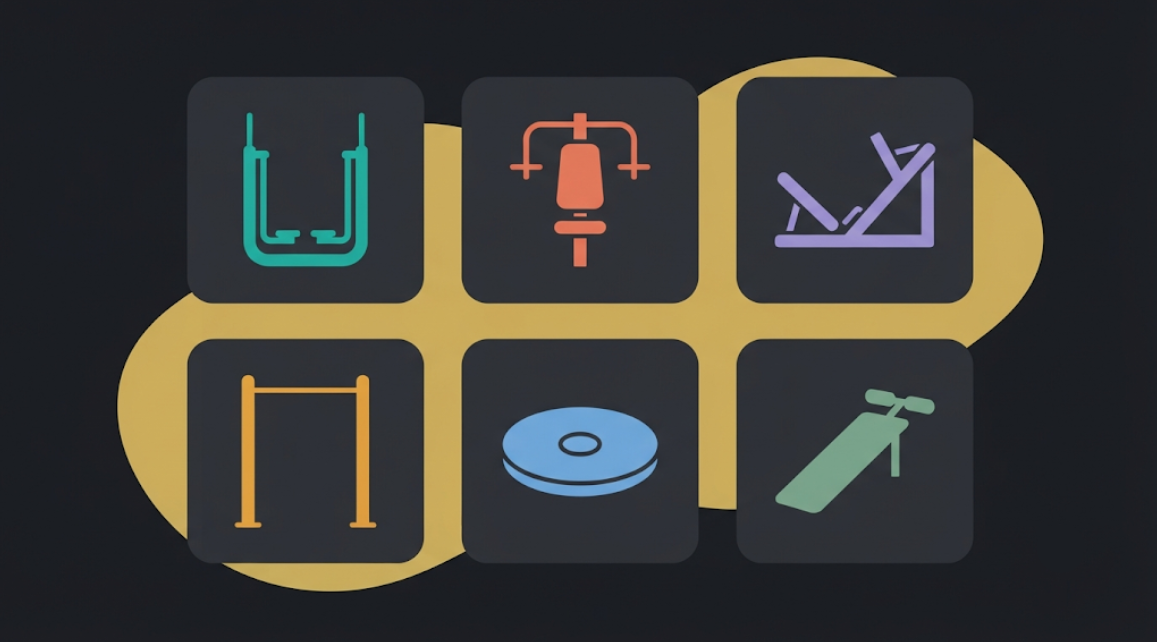
Cardio Equipment
Equipment | What you do | Good for |
Air walker | Stand on two footplates and swing your legs back and forth, holding the handles | Easy, low-impact cardio and warm-ups |
Cross trainer | Stand and move your arms and legs in a smooth, elliptical-style motion | Steady cardio for beginners and older adults |
Cross walker | A walking-style motion on swinging platforms | Gentle warm-up and mobility |
Cycle | Pedal while seated or semi-seated | Light cardio, legs |
Strength Equipment
Equipment | What you do | Good for |
Chest press | Sit and push handles forward | A simple pushing movement for the chest, shoulders and arms |
Leg press | Sit back and push a platform away with your legs | Lower-body strength with support for your back |
Seated puller | Sit and pull handles toward your body | A rowing-style pulling movement for the back and arms |
Chin-up bar | Hang and pull your body up | Real upper-body strength, and the best piece in the park for calisthenics |
Mobility Equipment
Equipment | What you do | Good for |
Arm and shoulder wheel | Rotate a wheel with your arms in big circles | Loosening stiff shoulders |
Twister | Stand on a rotating disc and twist your hips | Waist and spine mobility, in small, gentle amounts |
Legs trainer and horse rider | Move your legs or hips in a swinging or riding motion | Hip and leg mobility |
Air swing | Swing your legs from side to side while holding the frame | Hip mobility and warm-up |
Core Equipment
Equipment | What you do | Good for |
Abdominal board | Lie on an inclined board and sit up | Basic core strength |
Double or triple twister | Twist your torso on a rotating base | Light rotation work and balance |
Most of these have a fixed motion, so they're easy to learn. A lot of the resistance comes from your own body weight, which keeps them gentle for beginners and fairly limited for people who are already strong.
My Take: Open Gyms Are Good, With One Condition
I've used open gyms, and I think they're good. It's better to do something than nothing, and most of the equipment is decent for a proper calisthenics workout if you are strong enough for it. If you have a chin-up bar and some ground to work on, you have a gym.
The one condition is the area. In a well-kept neighbourhood, the equipment is usually in good condition, and you can get a solid session out of it. In a poorly maintained area, much of it is broken, loose or rusted, and it's mostly not usable for a good workout. That has nothing to do with the equipment type. It comes down to who looks after the place.
There's another way I've used them. When I didn't have any calisthenics equipment of my own and the gym was closed, I trained in my local park. It wasn't fancy, but it kept the habit alive, and that counts for more than the setup.
A Simple Open Gym Workout for Beginners

This circuit uses the common machines and takes about 40 minutes. Do each exercise for the sets and reps shown, rest 60 to 90 seconds between them and stop each set with a rep or two left in reserve.
Order | Exercise | Sets x reps | If it's not available |
1 | Air walker or cross trainer, easy pace | 5 minutes | Brisk walk around the park |
2 | Chest press | 3 x 10 to 12 | Push-ups on the ground |
3 | Seated puller | 3 x 10 to 12 | Inverted rows on a low bar if one exists |
4 | Leg press | 3 x 12 to 15 | Bodyweight squats |
5 | Chin-up bar | 3 x as many as you can with good form | Hanging holds or band-assisted pulls |
6 | Abdominal board | 3 x 10 to 15 | Reverse crunches on the ground |
7 | Arm and shoulder wheel | 2 x 1 minute each direction | Arm circles |
If you've trained with calisthenics before, skip the machines and build a session around the chin-up bar. Pull-ups or chin-ups, push-ups, bodyweight squats, lunges and leg raises cover most of what you need.
Check the Equipment Before You Use It
Public equipment gets heavy use and not much maintenance. Spend 30 seconds on each piece before you put your weight on it.
Look for visible rust, cracks or bent parts, especially at welds and joints.
Shake the frame and handles. Anything loose or wobbling should be left alone.
Check bolts and pins at moving parts, such as the footplates on an air walker.
Test the movement slowly before you speed up or load it.
Avoid metal that has been baking in the sun, since the handles can get uncomfortably hot.
If something is clearly unsafe, don't use it and report it to whoever maintains the park.
Open Gym vs Indoor Gym
Factor | Open gym | Indoor gym |
Access | Open to everyone, usually free | Membership needed |
Weather | Affected by rain, heat and pollution | Climate-controlled |
Equipment range | Limited, mostly bodyweight-based | Wide range of free weights and machines |
Progression | Harder to add load | Easy to add weight in small steps |
Crowd and noise | Varies, often quiet at off-peak hours | Can be busy at peak hours |
Condition of equipment | Varies a lot with the area | Usually maintained by the staff |
Best for | Beginners, calisthenics, mobility and cardio | Progressive strength training and variety |
They don't compete. Many people use open gyms for cardio, mobility and calisthenics, and a gym for heavier lifting.
Building an Open-Air Gym of Your Own
If you have a terrace, garden or open space, you can build your own open-air gym. A friend's company has a full terrace gym, covered with a shed. It has a squat rack, a dumbbell rack, a bench, plates and barbells, and that's it. Nothing fancy, and it covers almost everything you'd want to train.
That is a good model. Start with the essentials, protect them from the weather, and add more only when you need to.
Types of Open-Air Gym You Can Build
Type | What you need | Best for |
Bar corner (calisthenics) | A wall-mounted or free-standing pull-up bar, a mat and some ground space | Bodyweight training on a terrace, balcony or garden |
Covered terrace gym | Squat rack, barbell, plates, bench, dumbbell rack, a shed or roof and rubber flooring | Full strength training in all weather |
Garden free-weight area | Dumbbells, a bench, a mat and storage for taking weights indoors | Casual lifting on soft ground in good weather |
Society or community gym | Durable fixed equipment, shade, safe flooring and someone to look after it | Shared use by a whole housing society |
How to Build It, Step by Step
Choose a flat, firm spot. Soft ground like grass is fine for light work, but a firm base suits racks and heavy lifts.
Add flooring. Rubber mats or platforms protect the surface, make dropped weights less noisy and give you non-slip footing.
Cover it if you can. A shed, roof or canopy keeps you training in the rain and protects the equipment.
Pick equipment made for outdoor use. Galvanised or well-coated steel resists rust better.
Mix fixed and portable. Racks and bars can stay in place, but keep free weights in a dry spot when you aren't using them.
Leave room to move. Each piece needs space around it for you to perform the exercise safely.
Add storage. A dumbbell rack and a shelf for plates keep the area tidy and safe.
Keep a towel and a cloth nearby to wipe down the metal after rain, because moisture is what starts rust.
A Note for Housing Societies
If you want to suggest an open gym for your society, think about the practical questions first. Where will it go, and does the spot have shade? Is the ground level and safe? Who will inspect and maintain the equipment? What hours will it be open, and how will you handle children and older residents using it? A short, clear proposal with those answers gets a better hearing than a wish list of machines.
Keeping Open Gym Equipment in Good Shape
Wipe off sweat and rain. Moisture and salt cause rust, especially near the coast.
Check bolts regularly. Tighten anything loose and replace worn parts.
Touch up chipped paint. A small chip is where rust begins.
Keep it clean. Dust and bird droppings build up quickly outdoors.
Lubricate moving parts. Pins and rotating joints last longer when they move smoothly.
Common Mistakes at Open Gyms
Skipping the warm-up because the equipment looks gentle.
Using a damaged piece because nothing else is free.
Twisting too fast or too far on the twister and swing machines.
Staying on one machine for the entire session, instead of following a short circuit.
Ignoring the weather, such as training in peak midday heat.
Expecting a machine's fixed motion to replace proper strength training.
Conclusion
Open gym equipment isn't glamorous, but it works. The cardio and mobility pieces are good for beginners, and a chin-up bar gives you a proper calisthenics workout if you're strong enough for it. Check the condition of the equipment, follow a simple circuit and don't expect a machine with a fixed motion to do everything.
If you want more, a covered open-air gym with a rack, a bench, plates and barbells is all you need. Start with the basics and protect them from the weather. When you’re ready for heavier lifting, find a gym near you and keep the open gym for cardio and mobility days.
Note: This article is general information, not medical advice. If you have an injury or a medical condition, check with your doctor before starting a new routine, and stop any exercise that causes sharp pain.


