


Calisthenics vs Bodybuilding: Which Builds a Better Physique?
Scroll through fitness content long enough and you'll see both extremes, the lean, vascular calisthenics athlete pulling off a front lever with total control, and the bodybuilder with the kind of size and fullness that fills out a t-shirt in a way bodyweight training rarely produces. Both are undeniably fit. Both trained hard to get there. And both would give you a completely different answer if you asked them what a good physique actually looks like.
The honest starting point for calisthenics vs bodybuilding is that "better physique" and "who's stronger" are actually two separate questions, and each one has a different answer depending on what you're optimizing for. Online debates on this topic tend to collapse both questions into one, with each side insisting their training style wins outright. It doesn't, not in every sense. This guide breaks both questions down honestly, covers the physique, strength, recovery, and injury differences in detail, and ends with a practical answer for anyone trying to decide which approach actually fits their goals.
What Calisthenics Actually Builds
Calisthenics uses your own bodyweight as the primary resistance, pull-ups, push-ups, dips, squats, and their progressively harder variations, muscle-ups, pistol squats, handstand push-ups, front and back levers. Because your body has to move as one coordinated unit through most of these exercises, calisthenics tends to build a lean, well-defined physique with strength that transfers directly into real-world movement quality, balance, coordination, and control.
There's a structural reason calisthenics produces this particular look. You genuinely cannot skip weak links in the chain, if your core, grip, or shoulder stability isn't strong enough, you simply won't be able to perform harder progressions like a one-arm pull-up or a planche, no matter how strong your biceps are individually. That forces a kind of full-body development that's harder to avoid than it is in weight training, where a machine can isolate and prop up a weaker muscle group while you focus elsewhere.
What Bodybuilding Actually Builds
Bodybuilding is built around a different goal entirely, maximal muscle hypertrophy, meaning making individual muscles as large as possible through targeted, progressive overload with external weight. Training is typically split by muscle group across the week, chest day, back day, leg day, with specific exercises chosen to isolate and fatigue each area as completely as possible.
This targeted approach is what gives bodybuilders their characteristic size and symmetry. Because dumbbells, barbells, and machines let you add weight in small, controlled increments indefinitely, and because you can isolate a lagging muscle group directly rather than working around it, bodybuilding has a real structural advantage for building maximum size, particularly in areas that are naturally harder to develop through bodyweight training alone.
Calisthenics vs Bodybuilding: Who Is Actually Stronger
This depends entirely on how you define strength, and it's where a lot of online debates talk past each other without realizing they're measuring different things.
Strength Type | Calisthenics | Bodybuilding |
Absolute strength (how much weight you can move) | Limited by bodyweight and leverage, generally lower | Higher, external load can be increased indefinitely |
Relative strength (strength relative to your own bodyweight) | Very high, pound for pound among the strongest athletes in fitness | Lower relative to bodyweight, size often outpaces strength-to-weight ratio |
Functional/full-body strength | High, most movements require total-body coordination and control | Lower carryover, strength is often more isolated to the muscle being trained |
Measured by | Planche, front lever, one-arm pull-up, handstand push-up progressions | 1-rep max on bench press, squat, and deadlift |
A calisthenics athlete who can hold a full planche is producing an extraordinary amount of relative strength and body control, arguably more impressive pound for pound than most gym lifts. A bodybuilder who can squat twice their bodyweight is producing serious absolute strength that no amount of bodyweight training alone would replicate. Neither one is simply "stronger" than the other in every sense of the word, they're strong in different, genuinely non-comparable ways.
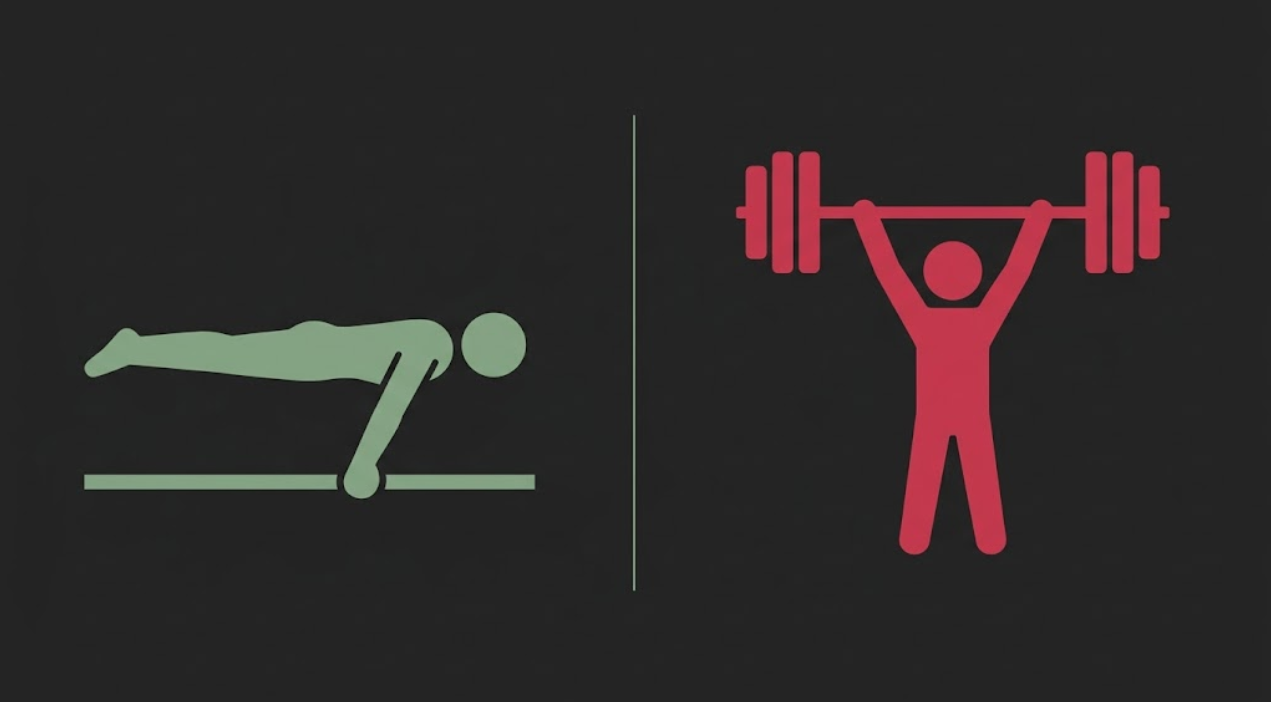
This distinction matters practically, not just academically. If your goal is moving heavy objects, whether that's in a strongman-style event or just everyday tasks like carrying furniture, absolute strength is what matters, and bodybuilding-style training builds that more directly. If your goal is controlling your own body through demanding positions, gymnastics-style movement, martial arts, or just feeling capable and coordinated in your own body, relative strength matters more, and that's where calisthenics has the clearer edge.
Calisthenics Physique vs Bodybuilding: The Real Visual Difference
The physique difference between the two is real and immediately visible, and it's a big part of why this comparison generates so much debate in the first place.
Calisthenics physique: leaner, lower body fat, visibly defined muscle with noticeable vascularity, a look often described as athletic or gymnast-like rather than bulky.
Bodybuilding physique: larger overall muscle mass, fuller chest, shoulders, and arms, a thicker, more filled-out look with an emphasis on symmetry between muscle groups.
Calisthenics vs bodybuilding body comparisons usually come down to this basic trade-off, size versus leanness and definition. A calisthenics-trained body tends to look proportionate and controlled, while a bodybuilding-trained body tends to look larger and more dramatically shaped. Neither is objectively the "good" physique, it depends entirely on which look you're actually going for.
Why Bodybuilding Has the Edge for Legs
This is one of the more consistent findings across coaches and practitioners who've trained both ways seriously. Upper body calisthenics progressions, pull-ups, dips, push-ups, scale reasonably well since your bodyweight itself provides meaningful resistance relative to those muscle groups. Legs are a different story, your bodyweight alone stops being much of a challenge for squats and lunges fairly quickly, and without added external weight, continuing to progressively overload the legs through calisthenics alone becomes genuinely difficult.
Bodybuilding-style leg training, with barbells, leg press machines, and progressively heavier loading, has a clear structural advantage here. Even committed calisthenics athletes often add weighted vests, resistance bands, or occasional weighted squats specifically to keep their leg development progressing at the same rate as their upper body.
Training Frequency and Recovery: How They Compare
How often you can train, and how quickly you recover between sessions, plays a bigger role in long-term progress than most comparisons acknowledge.
Calisthenics tends to be joint-friendly and allows relatively frequent training, since bodyweight movements generally place less compressive load on joints than heavy barbell work. Many calisthenics athletes train specific skills, handstands, hollow body holds, basic pulling and pushing patterns, close to daily, since the demand on the central nervous system is more moderate. That said, high-skill progressions like planche and front lever training are demanding on tendons and connective tissue, which adapt more slowly than muscle does, so overtraining these specific movements is a real risk even though the joints themselves feel fine.
Bodybuilding-style training, particularly heavy compound lifts like squats, deadlifts, and bench press, generally requires more structured recovery between sessions for the same muscle group, commonly 48 to 72 hours before hitting that muscle hard again. This is part of why bodybuilding programs are typically organized around a weekly split rather than daily full-body sessions, the volume and intensity per session is higher, so the recovery window needs to be longer.
Injury Risk: Calisthenics vs Bodybuilding
Neither discipline is inherently dangerous when programmed sensibly, but the injury patterns differ in a way worth understanding before you commit to one.
Calisthenics injury risk: tends to concentrate around the shoulders, elbows, and wrists, particularly with advanced skill work like planche and one-arm progressions, where the joint is placed under significant strain at end ranges of motion. Tendon and connective tissue injuries, which heal slowly, are the more common long-term concern.
Bodybuilding injury risk: tends to concentrate around the lower back, knees, and shoulders, usually from heavy compound lifts performed with breakdown in form, especially as the weight on the bar increases faster than technique can keep up.
In both cases, the injuries that actually happen are far more often the result of rushed progression, ego-driven loading, or poor form than something inherent to the training style itself. A calisthenics athlete who progresses through skill levels patiently and a bodybuilder who prioritizes form over ego lifting both train for decades without major issues. The risk profile is different, but neither one is safer by default if the fundamentals are ignored.
Calisthenics vs Bodybuilding: Which Is Better for You
The honest answer depends on what you're actually optimizing for.
Choose calisthenics if: you want a lean, functional physique, care about relative strength and body control, want to train with minimal or no equipment, and enjoy skill-based progressions like handstands and levers.
Choose bodybuilding if: your main goal is maximum muscle size, you want the ability to isolate and bring up specific lagging body parts, and you're comfortable training with dedicated gym equipment.
Choose neither exclusively if: you want the benefits of both, this is where a hybrid approach becomes genuinely worth considering rather than picking a side.
The Hybrid Approach: Getting Both
The two disciplines aren't actually in conflict, and many experienced trainees eventually land somewhere in between rather than staying loyal to one camp. Weighted calisthenics, adding a weight belt or vest to pull-ups and dips, closes much of the muscle-size gap for the upper body while keeping the functional, full-body-control benefits calisthenics is known for. For the lower body, where bodyweight training genuinely struggles to keep pace, incorporating bodybuilding-style barbell and machine work fills the gap that calisthenics alone tends to leave.
A practical hybrid split might use calisthenics for pull-ups, dips, push-ups, and core work, while relying on traditional weighted training for squats, deadlifts, and any specific muscle group that needs more precise, isolated overload. This combined approach tends to outperform either method used in isolation for most people who aren't specifically competing in one discipline or the other.
There's also a sequencing question worth considering if you're starting from scratch. Building a calisthenics foundation first, mastering strict pull-ups, dips, and push-ups with full control, tends to translate well into weighted training later, since the joint stability and body awareness carry over. Going the other direction works too, many bodybuilders find that adding calisthenics-style bodyweight work improves their mobility and joint health in ways their weighted programming alone doesn't address. Neither sequence is objectively correct, it mostly comes down to which style keeps you training consistently long enough to actually see results.
Conclusion
Calisthenics vs bodybuilding isn't a contest with a single correct winner, it's two different training philosophies optimized for two different outcomes. Calisthenics builds a leaner physique with exceptional relative strength, full-body coordination, and skill-based progressions, using minimal equipment. Bodybuilding builds greater overall size, symmetry, and absolute strength, with the ability to precisely target and bring up specific muscle groups, especially the legs, where calisthenics alone tends to fall short.
If you genuinely care about physique and strength in the fullest sense, the most effective path for most people isn't choosing one over the other, it's borrowing the best of both, calisthenics for control and leanness, weighted training for size and targeted growth. Whichever direction you start in, the training style that actually gets you the best physique long-term is the one you'll stay consistent with for years, not months, so weigh your own preferences and lifestyle as heavily as the physiological trade-offs covered here. If part of that plan means gym access for the weighted side of a hybrid approach, browse gyms near you to compare what's available.


