


Curved Treadmill: Complete Guide (2026)
Walk past one in a gym and it stands out immediately, a U-shaped belt curving up at both ends, no console full of speed buttons, no motor hum. A curved treadmill looks like a different piece of equipment entirely, and mechanically, it is. Here's what actually makes it different, whether the claims about it are legitimate, and who genuinely benefits from one.
How a Curved Treadmill Actually Works
A curved treadmill has no motor. The belt sits on a curved frame made of individual slats, and it moves entirely from your own effort, there's no button to set a speed. Instead, your position on the curve and how hard you push determine the pace, move toward the front of the belt and it speeds up, ease back and it slows down. Acceleration and deceleration happen instantly, since there's no motor lag to wait through.
Curved vs. Standard Treadmill: The Real Differences
The two machines share a basic purpose but work in genuinely different ways. If you want the fuller picture on standard motorized treadmills specifically, our full treadmill buying guide covers that ground in depth.
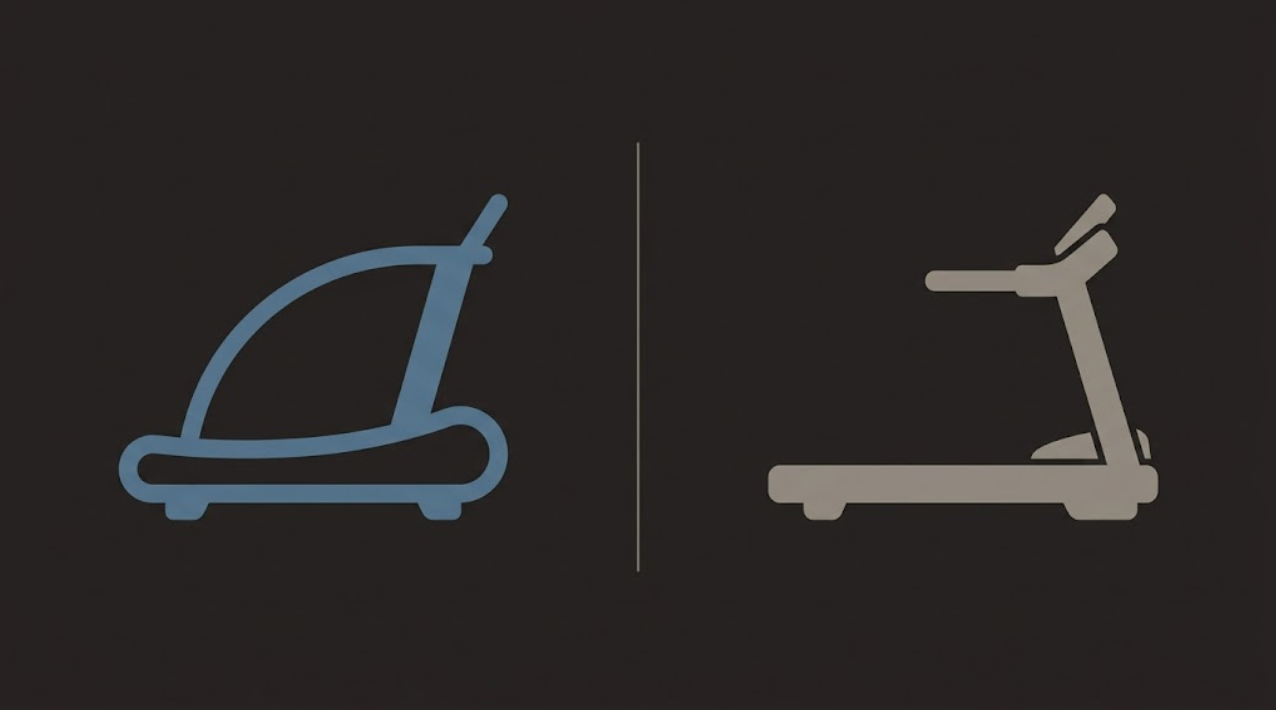
Factor | Curved Treadmill | Standard Treadmill |
Power source | Self-powered, no motor, no electricity needed | Motorized, requires a power outlet |
Speed control | Instant, controlled entirely by your stride and position | Set via buttons, slight lag when changing pace |
Incline | None needed, the curve itself provides resistance | Adjustable incline settings |
Running form | Encourages forefoot/midfoot strike and forward lean | Allows heel striking, more like typical indoor running |
Cost | Generally more expensive | Usually cheaper for a comparable quality tier |
Maintenance | No motor to service | Belt lubrication, motor upkeep over time |
Does a Curved Treadmill Burn More Calories
Likely yes, and by a meaningful margin. Several studies comparing curved and motorized treadmills at similar perceived effort have found runners on the curved version reach noticeably higher oxygen uptake and heart rate, with figures across different studies landing roughly in the range of 30 to 37% higher oxygen consumption and around 22% higher heart rate. The reason is straightforward: since you're powering the belt yourself, there's no assistance pulling your foot backward the way a motorized belt does, your body does genuinely more work for the same distance covered.
Who Should Actually Consider a Curved Treadmill
Sprinters and HIIT trainers: the instant acceleration and deceleration make interval work and sprint training noticeably smoother than waiting for a motorized belt to catch up.
Runners working on form: the curve naturally discourages heel striking and overstriding, useful if you're specifically trying to correct running mechanics.
Anyone without reliable power access: since it needs no electricity, it works in a garage, an outdoor covered space, or anywhere off-grid.
Serious cardio trainers wanting a harder session: if you're looking to increase workout intensity without changing the distance or time, the curved treadmill does that automatically.
Curved Treadmill Downsides to Know Before Buying
Harder to get started: since there's no motor assist, getting the belt moving and holding a truly steady pace takes more skill and effort than stepping onto a motorized machine.
Higher cost: curved treadmills generally cost more than a comparable motorized treadmill, the self-powered mechanism is more expensive to manufacture.
No incline control: the fixed curve provides its own resistance, so you can't dial in a specific incline percentage the way you can on a motorized machine.
Not a perfect outdoor-running substitute: the movement pattern is different enough from overground running that it's excellent conditioning but not a 1:1 replacement for road or track training.
Where Curved Treadmills Fit in a Home Gym or Commercial Setup
A curved treadmill works well as a dedicated conditioning and interval-training tool rather than your only cardio option. Many well-equipped gyms run both, a curved treadmill in the functional training area for conditioning work, and a standard motorized treadmill for steady-state running. If you're building this out at home, it's worth seeing the full range of core gym equipment to understand where a curved treadmill fits relative to other options, and pairing it with dumbbells rounds out a genuinely complete training setup rather than cardio alone.
Conclusion
A curved treadmill is a legitimately harder-working, more natural-feeling piece of equipment, not a gimmick, but it's not automatically the better choice for everyone. If you're doing interval training, working on running form, or want a tougher conditioning tool, it's worth the higher price and steeper learning curve. If you mainly want steady, predictable cardio sessions or precise pace control, a standard motorized treadmill will likely serve you better and cost less.
If you're weighing your options and want to try one before buying, browsing 24-hour gyms near you is a good way to test one out first.


