


Home Gym Equipment: Complete Guide (2026)
Building a home gym goes wrong in one of two predictable ways. Either you buy too little, a single pair of dumbbells that gets outgrown in a month, or you buy too much, an expensive all-in-one machine that turns into a clothes rack because it never quite matched how you actually wanted to train. Getting home gym equipment right means matching your purchases to your actual training goals and budget, not buying everything a catalog suggests. This guide walks through what to buy at each budget tier, whether an all-in-one machine is actually worth it, and where to actually buy each type of equipment.
Start With a Question, Not a Shopping List
Before buying anything, get specific about what you're actually training for. Someone doing general strength and conditioning needs a different setup than someone training specifically for muscle size, and both differ from someone whose main goal is cardio and weight loss. The equipment below is organized by budget tier, but within any tier, prioritize the pieces that match your actual goal over the ones that just look impressive in a home gym photo.
Basic Gym Equipment for Home: The Essentials Tier
If you're starting from nothing, these are the pieces that give you the most training variety per rupee spent.
Equipment | Why It Matters | Rough Price Range |
Adjustable or fixed dumbbells | The single most versatile piece of equipment, covers nearly every major muscle group | ₹2,000-₹8,000 depending on weight range |
Resistance bands | Cheap, portable, useful for warm-ups, activation work, and travel training | ₹500-₹1,500 |
Yoga mat | Essential for floor work, stretching, and core training | ₹500-₹1,500 |
Jump rope | Compact, effective cardio option that takes almost no space | ₹300-₹800 |
Pull-up bar (doorway-mounted) | Adds a genuine back and biceps training option without floor space | ₹800-₹2,500 |
This tier alone, running roughly ₹4,000 to ₹15,000 total, covers a genuinely complete beginner training routine. It's also the right starting point even if you eventually plan to spend more, these pieces stay useful at every budget level rather than becoming obsolete once you upgrade. Resist the temptation to skip straight to a more advanced setup before you've spent a few months actually training consistently, the essentials tier is enough to reveal what you genuinely enjoy and what direction you want to take your training in, which makes every purchase after this one more informed.
Mid-Range Home Gym Equipment: Building Real Capacity
Once the essentials are covered, this tier adds the equipment that lets you progressively overload and train with more structure.
Equipment | Why It Matters | Rough Price Range |
Adjustable weight bench | Opens up presses, rows, and incline work you can't do on the floor | ₹4,000-₹12,000 |
Barbell and plate set | The most efficient way to add serious weight for squats, deadlifts, and presses | ₹8,000-₹25,000 depending on total weight |
Kettlebells | Excellent for combined strength and cardio movements like swings and goblet squats | ₹1,500-₹5,000 per bell |
Basic cardio machine (cycle or compact treadmill) | Adds dedicated cardio capacity without needing outdoor space | ₹10,000-₹35,000 |
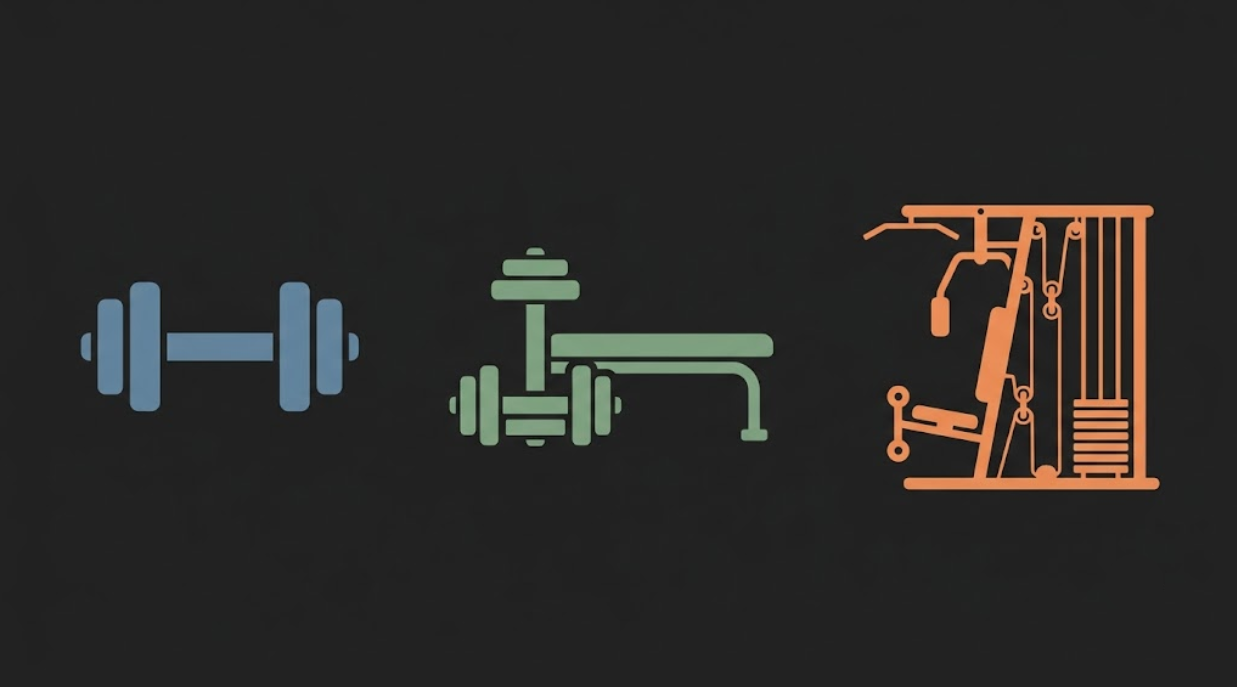
For a deeper breakdown of what to look for specifically in a treadmill, this treadmill buying guide covers motor power, belt size, and incline in detail, and this dumbbell buying guide goes further into weight selection and material choices than the summary above.
Flooring and Safety Considerations
Equipment gets most of the attention, but flooring is an easy thing to overlook until a dropped plate cracks a tile or a barbell dents the floor. Interlocking rubber gym tiles are a relatively small additional cost, usually a few thousand rupees for a modest home gym area, and they protect both your equipment and your flooring while reducing noise, a genuine consideration if you're training in an apartment with neighbors below. Beyond flooring, make sure your bench and rack, if you have one, sit on a level surface, and leave enough clearance around any barbell setup to fail a lift safely if needed.
Maintaining Your Equipment
Home gym equipment holds up well with minimal but consistent care. Wipe down benches and mats after sweaty sessions to prevent material breakdown over time, periodically check that bolts on any bench, rack, or machine haven't loosened, and store resistance bands away from direct sunlight, which degrades the rubber faster than normal use does. Dumbbells and plates need essentially no maintenance beyond keeping them dry if they're not rubber-coated, to avoid rust developing on bare steel.
Home Gym Equipment All in One: Are Multi-Gym Machines Worth It
Multi gym equipment, also called all-in-one or stack home gyms, combines several exercise stations, a lat pulldown, chest press, leg extension, and more, into a single frame using a shared weight stack. The appeal is obvious: one purchase, one footprint, dozens of possible exercises.
Where it makes sense: limited space where separate equipment pieces simply won't fit, or a strong preference for machine-guided movements over free weights, particularly for beginners still building confidence with form.
Where it falls short: these machines are significantly more expensive than building the equivalent capability piece by piece, and a shared weight stack means you can't use two stations simultaneously the way separate equipment allows. The exercise selection is also more limited than a true barbell and dumbbell setup, since you're working within whatever angles and cable paths the machine was engineered for.
A genuinely honest take: for most home gym builders, buying dumbbells, a bench, and a barbell set piece by piece delivers more training variety per rupee than an all-in-one machine, unless space is so limited that a single-footprint solution is the only realistic option.
Gym Equipment Set vs. Buying Individually
Pre-packaged gym equipment sets, often bundling dumbbells, a barbell, plates, and a rack in one purchase, are common in the Indian market and can offer modest savings over buying each piece separately. The trade-off is flexibility, a set locks you into whatever weight increments and rack style the bundle includes, while buying individually lets you build toward exactly the setup you want, adding pieces as your budget and training needs evolve. If you're confident about your training style and want to move fast, a set is a reasonable shortcut. If you're still figuring out what you'll actually use most, individual pieces give you more room to adjust.
Best Home Gym Equipment for Small Spaces
Space constraints shouldn't mean giving up on a real home training setup, it just means prioritizing differently.
Adjustable dumbbells: replace an entire rack of fixed pairs with one compact unit that adjusts weight in a small footprint.
A foldable or wall-mounted bench: gives you incline and flat pressing capability without a bench permanently taking up floor space.
Resistance bands and a doorway pull-up bar: together cover a surprising amount of upper body training with almost zero storage footprint.
A compact, foldable treadmill or cycle: keeps cardio accessible without dedicating a full room to it.
Where to Actually Buy: Gym Equipment Shop vs. Buying Online
Both routes work, and the right one depends on what you're buying. For dumbbells, plates, and other straightforward items, buying online from an established retailer is usually cheaper and more convenient, since these are simple enough products that seeing them in person adds little value. For larger purchases like a multi-gym machine, a bench, or a full rack, visiting a physical gym equipment shop lets you actually test the build quality, check the padding, and confirm the machine fits your space before committing, differences that photos alone can hide.
Home Gym vs. Gym Membership: Doing the Math
A complete mid-range home gym setup, essentials plus a bench, barbell set, and basic cardio machine, typically lands somewhere between ₹25,000 and ₹60,000 as a one-time cost. Compare that against your local gym membership fees over a year or two, and the math genuinely favors a home setup for a lot of people, provided you'll actually use it consistently. If you're still deciding, browsing 24-hour gyms near you is worth doing before committing to a full home setup, particularly if you value the space, equipment variety, or social environment a gym floor offers that a home setup can't fully replicate.
Building Up Gradually vs. Buying Everything at Once
There's a real temptation to place one large order and have a complete home gym show up in a week, but building gradually tends to produce a better long-term setup. Training for a few months on just the essentials tier reveals genuinely useful information, whether you gravitate toward barbell work or dumbbell training, whether cardio machines get used or whether you'd rather run outside, whether you actually have room for a bench or if it becomes clutter. Each of those answers changes what your next purchase should be, and spending everything upfront means guessing at all of it before you have any real data on your own habits.
A reasonable pace is reassessing every two to three months, adding the next piece that addresses whatever your current setup is missing rather than what looks appealing in an equipment catalog. This also spreads the cost out in a way that's easier on most budgets than one large upfront purchase, and it means every piece you do buy gets chosen based on actual training experience rather than a guess.
Conclusion
The best home gym equipment setup isn't the most expensive one, it's the one that actually matches your training goals, available space, and budget, built up in a sensible order rather than all at once. Start with the essentials tier regardless of your eventual budget, add mid-range pieces as your training demands more capacity, and be honest with yourself about whether an all-in-one machine or individual pieces better fit how you actually want to train.


