


6 Day Gym Workout Schedule: Complete Plan for 2026
Training six days a week sounds simple on paper. Pick a split, show up, repeat. The part most guides skip is that a 6-day commitment is as much a math problem as a training one, both for your body's recovery and for what you're actually paying per session at the gym. Get either one wrong and the whole plan falls apart within a month.
This 6 day gym workout schedule walks through a proven training structure, the recovery details that actually matter at this frequency, and something almost no workout guide covers: whether your gym membership is even set up to support showing up six times a week.
Is a 6-Day Gym Workout Schedule Right for You
This is worth being honest about upfront. A 6-day split is an intermediate to advanced approach. If you're new to training, three to four days a week with full-body or upper/lower sessions will build more muscle and strength than six rushed, under-recovered days, simply because beginners haven't built the work capacity or movement efficiency six-day training demands.
A 6 day gym workout schedule for muscle gain makes the most sense once you've been training consistently for at least six months to a year, you recover well between sessions, and you can realistically commit to being in the gym almost every day without your schedule or sleep falling apart.
The Complete 6-Day Gym Workout Schedule (Push/Pull/Legs x2)
The most effective and sustainable way to structure six weekly sessions is a push/pull/legs split, repeated twice, with one full rest day. This lets you train each muscle group twice a week, which research consistently shows builds more muscle than training it once, while keeping each individual session manageable.
Day | Focus | Key Lifts |
Monday | Push (chest, shoulders, triceps) | Bench press, overhead press, dips |
Tuesday | Pull (back, biceps) | Deadlift or rows, pull-ups, curls |
Wednesday | Legs | Squats, Romanian deadlifts, calf raises |
Thursday | Push (chest, shoulders, triceps) | Incline press, lateral raises, tricep work |
Friday | Pull (back, biceps) | Lat pulldowns, cable rows, face pulls |
Saturday | Legs | Leg press, lunges, hamstring curls |
Sunday | Full rest | No training, this is where the growth actually happens |
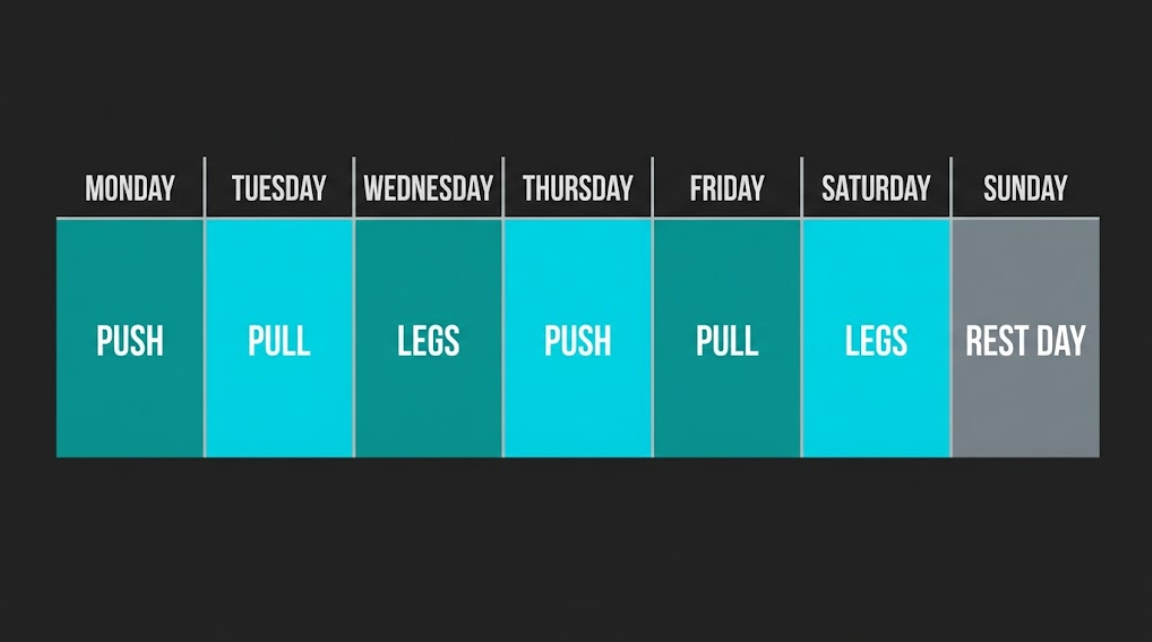
Each push and pull day doesn't need to be identical. A common approach is making the first session of each pair heavier and lower-rep, and the second session lighter with more volume, so your joints and nervous system get a break even while the muscle is still getting trained twice.
Sets, Reps, and Recovery for a 6-Day Split
Because you're training each muscle group more often, total weekly volume matters more than cramming everything into one brutal session. Aim for 3 to 4 sets per exercise in the 6 to 12 rep range for most lifts, leaving 1 to 2 reps in reserve on working sets and saving true failure for your last set only.
Recovery becomes the real limiting factor at this frequency. Sleep, protein intake, and managing stress outside the gym matter more here than on a 3 or 4 day plan, since you're giving your body far less downtime between sessions. If you notice your lifts stalling or your joints feeling consistently achy, that's your body telling you the volume needs to come down, not a sign to push harder.
Does a 6-Day Commitment Change Which Gym Membership Makes Sense
This is the part most workout guides never touch, but it matters. Once you're planning to walk into a gym six times a week, your membership type has a real effect on what each session actually costs you.
Membership Type | Typical Monthly Cost | Cost Per Session at 6x/Week (~24 visits) |
Budget gym (under ₹500/month) | ₹300 to ₹500 | ₹12 to ₹21 per session |
Mid-range gym | ₹1,500 to ₹2,500 | ₹63 to ₹104 per session |
Premium gym or class-based membership | ₹3,000 and up | ₹125+ per session |
The math flips depending on how often you actually show up. At six visits a week, even a mid-range or premium membership starts costing very little per session, which can be worth it if that gym has the equipment and space a 6-day split actually needs, enough squat racks, benches, and machines that you're not waiting around between sets. If you're still deciding where to go, it's worth taking a look at gym fees near you to compare what's actually available at each price point.
If budget is the priority and you don't need much beyond barbells, dumbbells, and basic machines, a budget gym under ₹500 a month can support a full 6-day split just as well as a premium one, since the training itself doesn't require anything fancy. On the other hand, if you're weighing a class-based or app-driven option, it's worth checking Cult.fit's membership pricing against a straightforward weightlifting gym, since class-based memberships aren't always built around the kind of repeated heavy lifting a 6-day PPL split needs.
Common Mistakes on a 6-Day Split
Skipping the single rest day: with only one day off, skipping it to "make up" a missed session removes the one recovery window your body actually gets. Protect that day.
Copying advanced volume as a beginner: a 6-day program built for someone with years of training experience will bury a newer lifter in fatigue. Scale the sets down if you're earlier in your training.
Not adjusting nutrition upward: six sessions a week burns meaningfully more energy than three or four. Under-eating on this schedule is one of the fastest ways to stall progress or start losing strength.
Conclusion
A 6 day gym workout schedule can deliver real, faster results, but only when the training structure and your recovery can actually support it, and only when your membership is set up in a way that makes showing up six times a week sustainable rather than an expensive habit you quietly drop after a few weeks.
Start with the push/pull/legs structure above, respect the one rest day you get, and take a few minutes to check whether your current membership actually fits how often you're planning to train. If it doesn't, browse gyms in your city before committing to a schedule your membership can't really support.


