


Resistance Training vs Strength Training: Are They the Same Thing?
Mostly yes, with one catch. Both mean making your muscles work against a load. The difference is what you are aiming for. Strength training chases the heaviest weight you can move. Resistance training is the wider umbrella, and it usually aims at building muscle, endurance and general fitness.
I used to think the two were the same thing, because everyone used the words interchangeably. Over the years I worked out what each one means and why it matters for how you train. This guide lays out the difference in plain terms, shows you what each looks like in a week of training, and helps you pick one.
Why People Mix Up the Two Terms
Gyms, apps, magazines and YouTube channels use the words loosely. A "strength workout" can be 12 reps of dumbbell curls. A "resistance workout" can be heavy squats. No official body I could find defines the two as separate activities, so the labels depend on who is speaking.
The most common way to separate them is by goal, and that is the way I'll use here. Treat the rep ranges below as typical guidance, not hard rules. Real programmes blend the two all the time.
Resistance Training vs Strength Training: Side by Side
| Strength training | Resistance training |
Main goal | Lift heavier, get stronger | Build muscle, endurance and general fitness |
Typical reps | Low, often around 1 to 5 per set | Moderate to high, often 8 to 12 or more |
Typical load | Heavy, close to your limit | Moderate, challenging but manageable |
Rest between sets | Long, often 2 to 5 minutes | Shorter, often 30 to 90 seconds |
Common tools | Barbells, heavy dumbbells, racks | Machines, cables, bands, dumbbells, bodyweight |
Feels like | Heavy, focused, few reps | Muscle burn, fatigue, a pump |
Best known for | Maximal strength | Muscle size and endurance |
Think of resistance training as the umbrella. Strength training sits under it as a specific style, heavy and low rep. That is why you can say every strength session is resistance training, but not every resistance session is a strength session.
The Sliding Scale
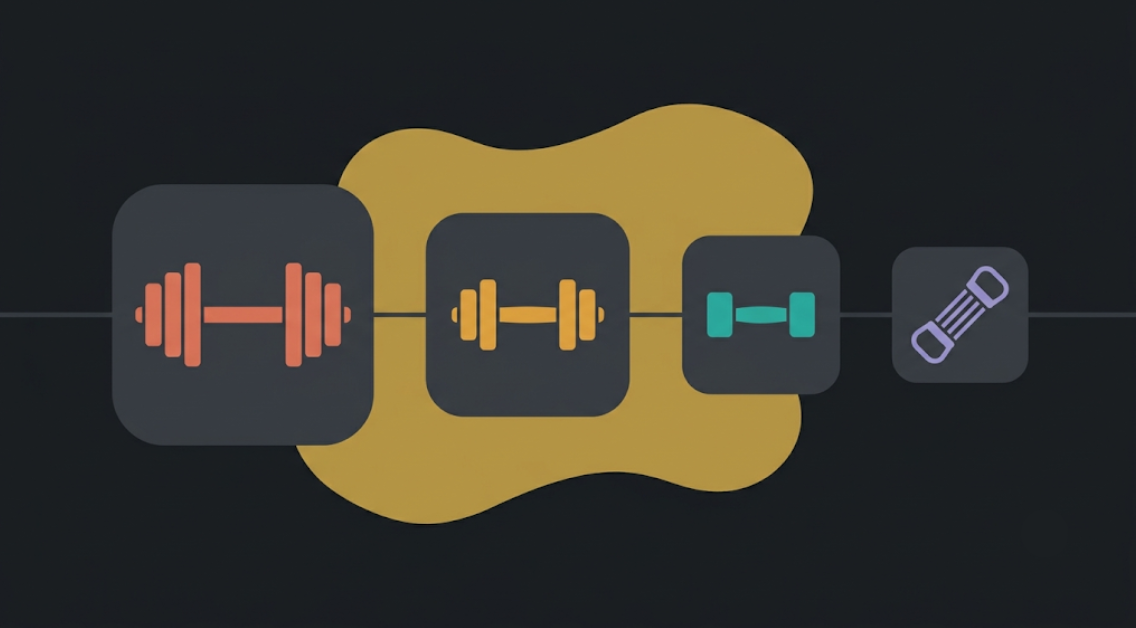
It helps to see this as a scale, not two boxes. Move along the scale by changing the weight, the reps and the rest.
Style | Reps per set | Rest | What it mainly builds |
Heavy strength work | 1 to 5 | 2 to 5 minutes | Maximal strength |
Mixed strength and size | 6 to 10 | 1.5 to 3 minutes | Strength and muscle size |
Muscle-building work | 8 to 12 | 1 to 2 minutes | Muscle size, some strength |
Endurance-leaning work | 12 to 20 | 30 to 60 seconds | Muscular endurance |
You can build strength at higher reps and size at lower ones, so the boundaries blur. This is a guide to where the emphasis lies, not a wall.
My Experience: I Almost Never Trained for Strength
I do weight lifting, calisthenics, plyometrics and running, and I've played football for over 12 years. Out of all that, I almost never trained purely for strength, meaning heavy, low-rep sets built around a maximum. I understood the difference quite early on, and I trained for muscle, general fitness and sport instead.
For me, calisthenics counts as resistance training. You are working against your own body weight, usually in a moderate rep range. I can see how it becomes strength training too, when you move to harder variations that you can only do for a few reps. The line moves with the difficulty, not with the equipment.
What I Think Footballers Get Right
As a footballer, I do both, depending on what the work is for. The way I separate them is simple.
Strength work is skill-based. It's aimed at a specific demand of the sport, so the exercise and the load are chosen with a purpose.
Resistance work is general. It's about learning how to use your muscles and building a stronger core and body overall, so everything else you do holds up better.
That split works outside football too. Ask what each session is for. If it's for one specific thing you want to do better, treat it as strength work. If it's about being a sturdier, more capable body, treat it as resistance work.
A Common Mistake: Training for Strength the Wrong Way
From what I've seen, people are more aware of the difference than they used to be. Many of those who say they are training for strength still don't use the right techniques or approach for it. A few signs show up again and again.
Chasing heavy weights without warm-up sets, so the first working set is a shock.
Cutting rest short, which defeats the purpose when you are lifting close to your limit.
Letting form fall apart as the weight gets heavier.
Never writing anything down, so there is no plan to progress.
Doing the same weight and reps for months.
Strength work is simple but it is not casual. It needs warm-up sets, long rests, strict form and slow, deliberate increases in load. If you want to try it, learn the main lifts from a qualified trainer first.
Which One Should You Do?
If your goal is... | Lean towards | Why |
Getting stronger on big lifts | Strength training | Heavy, low-rep work is the direct route |
Building muscle size | Resistance training | Moderate reps and volume suit muscle growth |
Looking more toned | Resistance training | Muscle plus lower body fat creates the look, and moderate reps build the muscle |
Losing fat | It protects muscle while you eat less | |
General health | A mix of both | Variety covers strength, size and endurance |
Playing a sport | A mix, based on the sport | Skill-specific strength plus general conditioning |
Older adults | Resistance training, with guidance | Moderate loads that you can control are a safer start |
What the Guidelines Say
Health guidelines don't make us pick one. The World Health Organization's 2020 guidelines recommend muscle-strengthening activities on two or more days a week for adults, alongside 150 to 300 minutes of moderate-intensity aerobic activity. It doesn't matter whether you call those sessions strength or resistance. What matters is that you do them regularly.
Two Myths I'd Throw Out
Myth 1: Resistance training is only for bodybuilders
It isn't. Anyone can use resistance bands, machines, dumbbells or their own body weight to get stronger and fitter. You don't need to want a big physique to benefit.
Myth 2: Strength training makes you bulky
Getting stronger doesn't automatically mean getting big. Size tends to depend on how much you eat and how much training volume you do. Plenty of people lift heavy and stay lean. This worry stops many people, especially women, from picking up a barbell, and it shouldn't.
A Sample Week for Each Style
Here are two simple weeks so you can see the difference. Use the one that fits your goal, and warm up before every session.
Day | Strength-leaning week | Resistance-leaning week |
Monday | Squat 5 x 3 to 5, rows 3 x 5 | Leg press 3 x 10 to 12, chest press 3 x 10 to 12 |
Tuesday | Rest or easy walk | Walk or light cardio |
Wednesday | Bench press 5 x 3 to 5, pull-ups 3 x 5 | Rows 3 x 10 to 12, shoulder press 3 x 10 to 12 |
Thursday | Rest or easy walk | Rest |
Friday | Deadlift 4 x 3 to 5, overhead press 3 x 5 | Lunges 3 x 10 per leg, lat pulldown 3 x 10 to 12, core circuit |
Weekend | Rest, light activity | Rest, light activity |
Choose weights that leave you with a rep or two in reserve on most sets, and rest longer on the strength days than the resistance days. If you've never done heavy low-rep work, start light and build up over several weeks.
How to Mix Both in One Week
You don't have to choose. A lot of people get good results with one or two heavy sessions and one or two moderate-rep sessions. The easiest way is to start each session with one heavy lift and finish with lighter work.
Day | Focus | Example |
Monday | Strength first, then resistance | Squat 4 x 4 to 6, then leg curls and lunges 3 x 10 to 12 |
Wednesday | Resistance | Rows, chest press and shoulder press, 3 x 10 to 12 each |
Friday | Strength first, then resistance | Bench press 4 x 4 to 6, then pull-downs and curls 3 x 10 to 12 |
Weekend | Optional light session | Bands, bodyweight or a walk |
The heavy lift comes first because that is when you're freshest and your form is best. The lighter work comes after, because moderate loads are easier to control once you're tired.
What You Need for Each Style
Equipment | Useful for strength training | Useful for resistance training |
Barbell and rack | Yes, the main tool | Yes, with lighter loads |
Dumbbells | Yes, if heavy enough | Yes, very versatile |
Machines and cables | Limited, mostly for assistance work | Yes, easy to control |
Resistance bands | Limited | Yes, good for home and warm-ups |
Bodyweight | Yes, with hard variations | Yes, for most beginners |
You can do either at home or in a gym, but heavy strength work is easier to do safely with a rack, bumper plates and someone nearby. For resistance work, a pair of dumbbells and a few bands cover most of what you need.
How to Progress in Either Style
Progress means giving your body a reason to adapt. The method is the same in both styles, only the numbers differ.
Strength training. Add a small amount of weight when you can complete all your sets and reps with good form. Small jumps, such as 2.5 kg on the bar, add up over weeks.
Resistance training. Add a rep to each set until you reach the top of your rep range, then increase the weight a little and drop back to the lower end.
Both. Write down your lifts. If you can't see progress on paper, you can't tell whether the plan is working. Every few weeks, take an easier week to recover.
Beginner Mistakes to Avoid
Treating them as opposites. They overlap, and most people do best with a mix.
Going heavy before you learn the form. Technique first, load second.
Skipping progression. Add a rep or a little weight over time, or nothing changes.
Rushing the rest. Short rests suit resistance work. Heavy sets need longer breaks.
Ignoring recovery. Sleep and food are part of the programme.
Conclusion
Resistance training and strength training aren't opposites. Resistance training is the broad category, and strength training is a specific style inside it, aimed at lifting heavy for low reps. The right choice depends on what you want the work to do for you.
If you're starting out, begin with resistance work, learn the movements, and add heavy low-rep work later if you want to get stronger on specific lifts. Ask what each session is for, and you won't go far wrong. If you want a rack and platform for heavier work, find a gym near you that has them.
Note: This article is general information, not medical advice. If you have an injury, a heart condition or are pregnant, check with your doctor before starting a new training programme, and learn heavy lifts from a qualified trainer.


