


Pilates vs Yoga: What's the Real Difference?
Both involve a mat, slow movement and a lot of attention to breathing, so it's easy to assume pilates vs yoga is a choice between two names for the same thing. It isn't. They were built for different reasons, they feel different in the body, and one will suit you better depending on what you want from a class.
Here is the short version. Pilates is about controlled, precise strength, mostly through the core. Yoga is about flexibility, balance and calm, with strength as a by-product. This guide breaks down the differences, covers beginners, weight loss and back stiffness honestly, and ends with a simple way to choose.
The Short Answer: Which One Should You Pick?
If you only read one section, read this.
Pick Pilates if you want a stronger core, better posture, controlled movement and a workout that feels like exercise from the first minute.
Pick yoga if you want more flexibility, a way to unwind, and a practice that combines movement with breathing and stillness.
Pick either if you simply want a gentle, low-impact habit. The best one is the class you will actually keep attending.
Neither is a strong calorie burner on its own, and neither is risk-free if you push through pain. More on both below.
What Is Yoga?
Yoga is an ancient practice from India that combines physical postures, breath control and meditation. Modern studio yoga is mostly the postural side, called asana, set to a rhythm of breathing. Styles vary a lot. Hatha is slow and foundational, vinyasa links poses into a flowing sequence, power yoga is more athletic, and hot yoga is practised in a heated room.
That variety is worth remembering, because a gentle evening class and a fast power class barely resemble each other. When someone says yoga is easy or hard, ask which kind they mean.
What Is Pilates?
Pilates was developed by Joseph Pilates in the early 20th century, and he called his method Contrology. It is a system of controlled exercises that emphasise the deep muscles of the trunk, the pelvis and the spine, often described together as the core. Movements are small, precise and done with focus on alignment and breathing.
It comes in two main forms. Mat Pilates uses your body weight, sometimes with small props like a ring or a band. Reformer Pilates uses a sliding carriage with springs that add resistance, so the same movements feel harder and more supported at once.
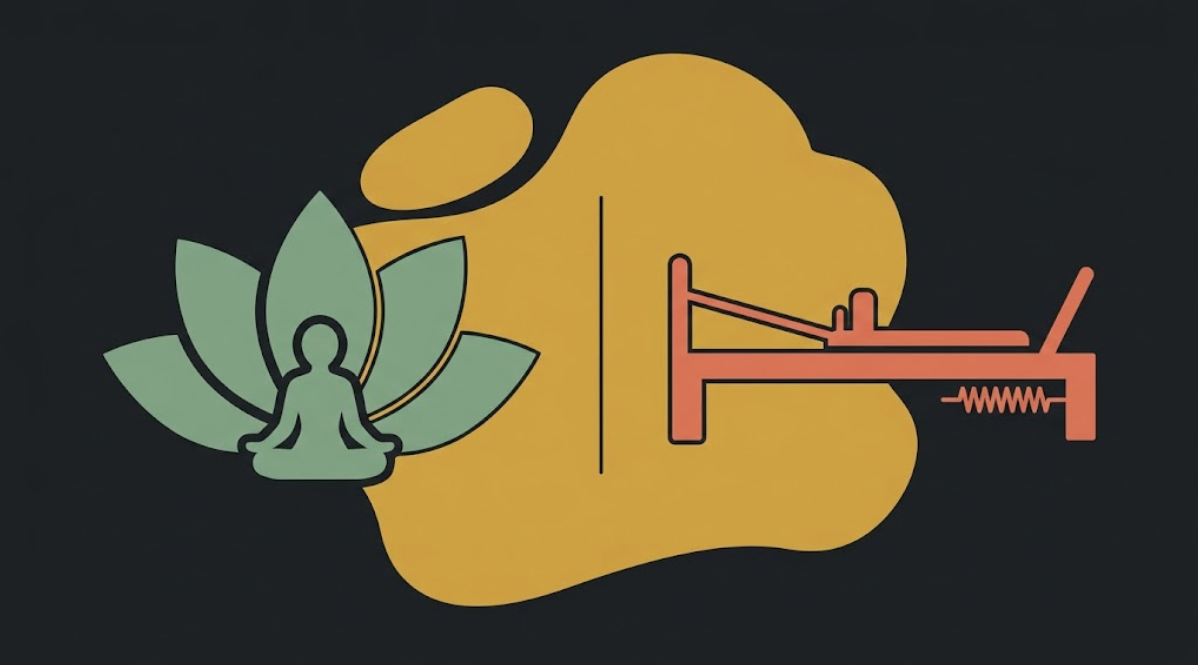
Pilates vs Yoga: Side-by-Side Comparison
Feature | Yoga | Pilates |
Main focus | Flexibility, balance, calm and mobility | Core strength, posture and controlled movement |
Origin | Ancient India | Early 20th century, developed by Joseph Pilates |
Pace | Slow and held, or flowing, depending on style | Steady and controlled, with repeated small movements |
Breathing | Central to the practice, often paced to the movement | Used to support the core and keep the movement controlled |
Mind-body element | Strong, often includes meditation or relaxation | Present, but centred on concentration and form |
Equipment | A mat, sometimes blocks and straps | A mat for mat Pilates, a reformer machine for studio classes |
Feels like | Stretching and holding, plus calm | Muscle fatigue deep in the trunk and legs |
Best for | Stiffness, stress, flexibility | Core strength, posture, rehab-style training |
Pilates vs Yoga for Beginners
Both are beginner friendly, but the first class feels different.
A beginner yoga class usually moves through simple standing and floor poses, with the teacher demonstrating and offering easier versions. You may feel tight, a bit wobbly in balance poses, and surprisingly relaxed at the end. The main difficulty is flexibility, and props like blocks help with it.
A beginner Pilates class usually starts with learning to engage your deep abdominal muscles and keep your spine in a neutral position, then repeats small movements. It can feel awkward at first, because you are learning to move specific muscles on purpose. By the end, many people notice their abs, glutes and thighs working in a way they didn't expect from such small movements.
If you are very stiff, yoga with props is kind. If you are not stiff but feel weak through the middle, Pilates may feel more satisfying quickly. In both cases, a beginner or foundations class beats jumping into a mixed-level one.
Mat Pilates vs Reformer Pilates
Mat Pilates is the cheaper and more accessible form. You can learn it in a group class or from a qualified instructor and then practise at home. Reformer Pilates takes place in a studio with specialised machines. The springs let an instructor adjust the resistance for each person, which is helpful if you are building strength after a layoff or working around a limitation.
Reformer classes are usually smaller and cost more, and they are mostly offered in dedicated studios rather than regular gyms. For most beginners, starting with mat classes to learn the basics and trying reformer later is a sensible route.
Pilates vs Yoga for Weight Loss
Let's be honest. Neither one is a big calorie burner, and neither will melt fat without changes to food and other exercise. Estimates from standard activity tables suggest roughly the following for a person of average size. These are modelled estimates, not measured results, and they swing with your body weight and the intensity of the class.
Class type | Approximate calories per hour |
Gentle hatha yoga | Around 150 to 200 |
Vinyasa yoga | Around 175 to 225 |
Power yoga | Around 250 to 300 |
Pilates (general) | Around 200 to 230 |
Reformer Pilates | No standard value, varies by class |
So a fast yoga class can burn more than Pilates, and a gentle yoga class can burn less. The more useful point is that both burn less than brisk walking, running or a hard strength session. Where they help with weight loss is consistency. If a class makes you show up four times a week, it will do more for you than a harder workout you skip.
If fat loss is your main goal, combine either one with strength training, daily walking and a modest calorie deficit. Treat yoga or Pilates as one part of the plan, not the plan itself.
Strength, Flexibility and Posture
Core strength. Pilates targets the deep trunk muscles more deliberately, so it tends to feel more demanding on the abs and lower back muscles.
Flexibility. Yoga puts more emphasis on holding stretches and reaching end ranges, so it tends to improve mobility more directly.
Balance. Both help. Yoga uses standing and one-leg poses, while Pilates builds the trunk control that supports balance.
Posture. Pilates teaches you to position the spine and pelvis. Yoga builds awareness and mobility. Both can help if you sit at a desk all day.
Stress. Yoga is more explicitly built around calming the mind. Pilates demands concentration, which many people find calming too, but it is a different feel.
Back Pain, Injuries and Safety
Many people try yoga or Pilates because of a stiff back, and physiotherapists often use similar movements in rehabilitation. But neither is a treatment, and both can aggravate an injury when done wrongly or too hard. We haven't cited specific trial results here, because the evidence varies by condition and study quality.
A few sensible rules help. Tell the instructor about any injury before the class starts. Skip poses or movements that cause sharp pain. Avoid deep twists or forward folds if you have a disc problem unless a professional has cleared it. Choose a qualified teacher, and for anything beyond mild stiffness, see a doctor or physiotherapist first.
Common Myths About Pilates and Yoga
"Yoga is only stretching." Holding poses like chair, plank or warrior takes real strength, and flowing classes raise the heart rate.
"Pilates is only for dancers or women." Pilates was created by a man and is used by athletes, office workers and older adults of every gender. It is a general conditioning method.
"You must be flexible to do yoga." That is like saying you must be fit before going to the gym. The practice is how you get more flexible.
"Either one gives you a flat stomach." Core strength is not the same as losing belly fat. You can strengthen the muscles without changing the fat that sits over them.
"They're the same thing." They overlap in breathing and low-impact movement, but the goals, the pace and the feel of a class are different.
Dropping these myths makes the decision easier. You aren't choosing between a stretching class and an ab workout. You are choosing a style of movement you enjoy.
Cost and Finding Classes in India
Both are widely available. Yoga is the easier of the two to find, with classes in parks, community centres, gyms and dedicated studios, and plenty of online options. Pilates is concentrated in dedicated studios and larger gyms in metro areas, and reformer classes in particular tend to cost more than regular group classes.
Prices change between cities and studios, so we haven't listed figures. When comparing, ask about the cost per class rather than the monthly package alone, whether a trial class is available, and how many people attend each class. Small groups mean more correction, which matters for beginners.
Can You Do Both?
Yes, and many people do. They complement each other well because yoga gives you mobility and calm while Pilates builds trunk strength. A simple week might look like this.
Day | Session | Why |
Monday | Pilates class (mat or reformer) | Core strength and posture |
Wednesday | Yoga class | Mobility and unwinding mid-week |
Friday | Pilates or strength session | Build strength |
Saturday | Yoga or a long walk | Active recovery |
Other days | Walking, rest or light stretching | Recovery and daily movement |
If your budget allows only one, choose by the main problem you want to solve.
Which Should You Choose?
If you... | Choose |
Want a stronger core and better posture | Pilates |
Feel stiff and want more flexibility | Yoga |
Are stressed and want to unwind | Yoga |
Want a more structured, exercise-like workout | Pilates |
Are recovering from an injury with medical clearance | Pilates, guided by a qualified instructor, or gentle yoga |
Want the cheapest and easiest to try | Yoga, with free online or community classes |
Can't decide | Book a trial class of each and compare |
Conclusion
Pilates and yoga are both good, low-impact ways to move more, and the real difference is feel and focus. Pilates is controlled core strength. Yoga is flexibility and calm. Pick by what you want, try one trial class of each if you can, and stay with the one you look forward to.
For fat loss or serious strength, add walking and lifting. For anything involving pain or an injury, talk to a professional first. To try both, find a gym near you that runs yoga and Pilates classes and book a trial.
Disclaimer: This article is general information and is not medical advice. If you have an injury, back or joint problems, a heart condition or are pregnant, talk to your doctor before starting yoga or Pilates, and tell your instructor before the first class.


