


How to Lose Weight Fast: A Step-by-Step Guide
Nobody searching for how to lose weight fast wants to hear the word slowly. So here is the deal. I'll give you the fastest approach that doesn't wreck your muscle, your mood, or your next six months, and I'll be blunt about what won't work.
The short version is this. Eat a bit less than you burn, walk a lot, lift weights twice or three times a week, sleep properly and keep going for months. That is the whole method. If you want to lose weight fast, the speed comes from doing those things every single day, not from a trick.
The Honest Version of 'Fast'
A safe pace for most adults is roughly half a kilo to one kilo a week. That sounds disappointing next to the 10 kg in 10 days promised by half the internet. It is also the pace people can sustain, and sustaining it is the only reason any of this works. Crash diets give you a dramatic first week, mostly water, then a rebound that is often bigger than the loss.
Looks fast, goes wrong | Fast enough, and it holds |
Skipping meals or eating one tiny meal a day | A moderate deficit spread across normal meals |
Cutting out whole food groups | Smaller portions and swaps on the same foods you like |
Hours of cardio on an empty tank | |
Detox teas, juices and fat burners | Protein, fibre, water and sleep |
Weighing yourself five times a day | Weekly averages, a tape measure and your lifts |
Treat the half to one kilo range as general guidance, not a promise. Heavier people tend to lose faster at the start, and lighter people slower. If your weekly number is in that neighbourhood, you are doing it right.
Step 1: Find Your Real Starting Point
Before you chase a number, check where you actually stand. Indian guidelines use lower cutoffs than the global charts, because we carry health risk at smaller sizes.
Measure | Indian cutoff |
BMI, overweight | 23 to 24.9 |
BMI, obesity | 25 or above |
Waist, men | 90 cm or more counts as abdominal obesity |
Waist, women | 80 cm or more counts as abdominal obesity |
Waist-to-height ratio | Above 0.5 is a warning sign |
India’s 2025 revision now defines obesity from a BMI above 23, adding waist and waist-to-height criteria. Measure your waist halfway between your lowest rib and the top of your hip bone. BMI is a rough screen and misreads very muscular people, so the waist number is the one I'd watch.
Step 2: Set a Deficit You Can Live With
Fat loss needs a calorie deficit. There is no way around that, and anyone selling a way around it is selling something. A deficit of roughly 300 to 500 kcal below what you burn is moderate and workable for most people, and it lines up with that half-kilo-a-week pace.
You don't need an app or a calculator to start. Begin by cutting the easy calories, the ones you barely notice. Sweet chai several times a day, packaged juice, evening biscuits, a second helping of rice. Do that for two weeks and watch your waist. If nothing moves, trim portions a little more. If you feel exhausted, dizzy or irritable all day, you have cut too much.
One honest warning. If you have ever had an eating disorder, or counting food makes you spiral, skip the strict numbers and work with a doctor or dietitian instead.
Step 3: Fix Your Plate, Not Your Personality
You do not need a new diet identity. You need your normal Indian food, with a few changes that stack up.
Instead of | Try | Why it helps |
Three rotis plus a big pile of rice | Two rotis and a small portion of rice, or rice only at one meal | Fewer calories with no hunger drama |
Dal as a thin side | A proper bowl of dal at lunch and dinner | Protein and fibre keep you full |
Only sabzi and roti | Add paneer, eggs, curd, chicken, fish or soya | A palm-sized protein serving at each meal |
Fried snacks with evening tea | Roasted chana, a fruit or a handful of nuts | Cuts easy calories without feeling like punishment |
Cold drinks, sweet chai, juice | Water, plain tea, buttermilk or black coffee | Liquid calories rarely fill you up |
Late-night heavy dinner | An earlier, lighter dinner with protein | Less grazing afterwards |
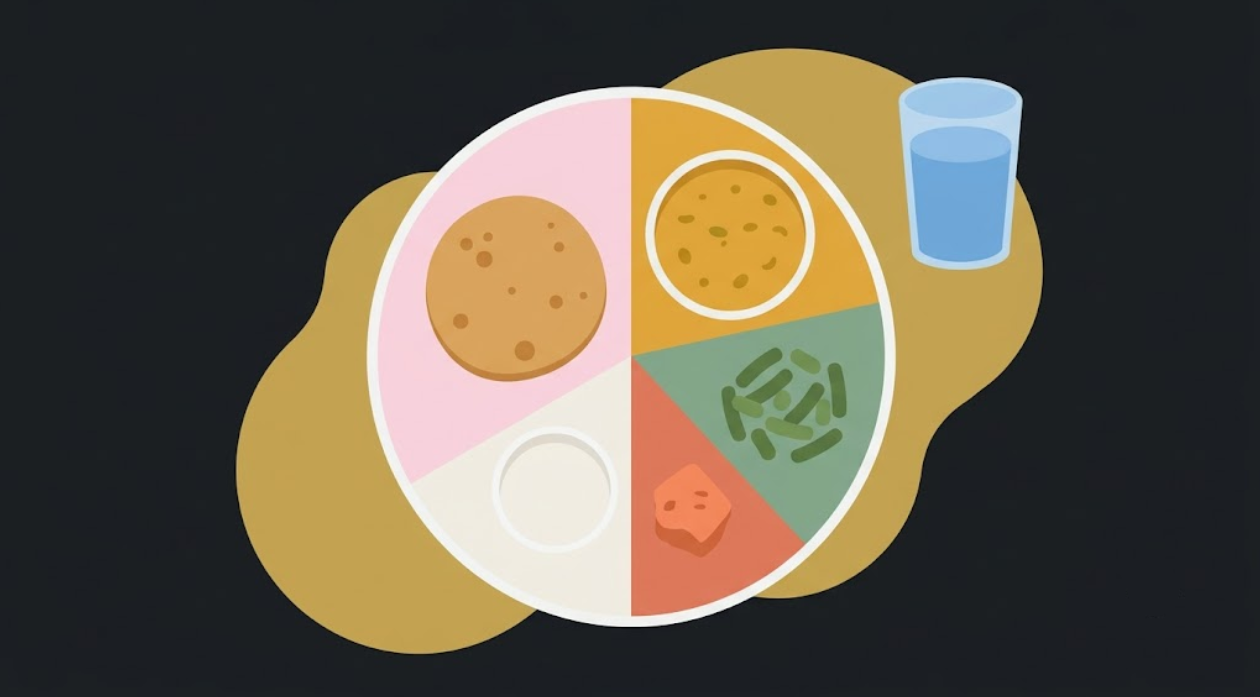
Here is what a normal day can look like. Treat it as an example to adjust, not a prescription.
Meal | Example |
Breakfast | Vegetable besan chilla or egg omelette with a roti, plus tea without sugar |
Mid-morning | A fruit and a glass of water |
Lunch | Two rotis, a bowl of dal, a plate of sabzi, curd and salad |
Evening | Roasted chana or a handful of nuts |
Dinner | Paneer, chicken or fish with sabzi and one roti or a small portion of rice |
Step 4: Walk More Than You Think, Then Lift
Walking is the most underrated fat loss tool there is. It's easy on the joints, it barely raises hunger, and you can do it every day. Start with whatever step count you do now and add a couple of thousand steps. Then keep adding.
Lifting comes next, and it matters more than most people believe. When you eat less, your body is happy to burn muscle along with fat. Strength training tells it to hold on to the muscle. That is the difference between losing weight and losing fat, and it is why two people at the same weight can look completely different.
Day | What to do |
Monday | Full-body strength: squat or leg press, push, pull, hinge |
Tuesday | Brisk walk of 40 minutes |
Wednesday | Full-body strength: lunges, shoulder press, row, glute bridge |
Thursday | Walk, plus 15 to 20 minutes of intervals if your knees are fine |
Friday | Full-body strength again, a little heavier than Monday |
Saturday | A long walk, a sport or a class you enjoy |
Sunday | Rest |
For strength sessions, pick a weight where the last couple of reps are hard but your form holds, and do around three sets of 8 to 12. Add a rep or a little weight over time. If you have never lifted, learn the basics from a qualified trainer for a few sessions, because good form saves you months of niggles.
Step 5: The Boring Stuff That Decides It
This is where plans quietly fall apart, so I'll keep it short.
Sleep. Aim for 6 to 8 hours. Short sleep makes you hungrier and weakens your willpower the next day. If you sleep five hours, fixing that will do more than any new exercise.
Alcohol. It carries 7 kcal per gram, nearly as much as fat, and it lowers your guard around food. If you drink, cutting back is one of the quickest ways to move the waist.
Stress. When life is on fire, the biscuit tin gets visited. You can't remove stress, but a daily walk is a decent pressure valve.
Step 6: Track Like a Scientist, Not a Judge
Your weight will jump up and down by a kilo or more from day to day because of water, salt and what you ate last night. That noise tells you nothing. So track these instead.
Weigh yourself a few mornings a week and look at the weekly average.
Measure your waist once every two weeks, in the same place.
Log your lifts. More weight or reps means you are keeping muscle.
Take a photo once a month in the same light. The mirror lies, photos less so.
Give any change four weeks before judging it. One bad week means nothing.
What the First Month Looks Like
Week | What you are doing | What to expect |
Week 1 | Cut easy calories, walk daily, learn the lifts | A drop on the scale, partly water. Don't celebrate or panic |
Week 2 | Add protein at every meal, start the strength days | Hunger settles, clothes may feel slightly different |
Week 3 | Increase steps, add a rep or weight to your lifts | Steadier weekly average, energy improves |
Week 4 | Review the waist, photos and lifts | A visible shift in the tape, and the habit starts to feel normal |
If this looks slower than your expectations, good. A month of this and you are ahead of the person who crash-dieted for ten days and quit.
Eating Out, Weddings and Festivals
Real life has a habit of arriving mid-plan. Weddings, Diwali, office lunches and the odd family dinner will happen, and a plan that can't survive them isn't much of a plan. You don't have to skip them. You just need a few rules of thumb.
Situation | What to do |
Restaurant meal | Start with a protein dish like tandoori chicken, paneer tikka or dal, then add a roti instead of naan |
Wedding buffet | Fill half your plate with salad and sabzi first, take a small portion of the heavy dishes and go back only if you're still hungry |
Festival sweets | Pick the one you like most, eat it slowly and skip the rest |
Office or family lunch | Eat your usual portion, don't starve beforehand and walk for 15 minutes afterwards |
Travel days | Carry roasted chana or nuts so you aren't buying fried snacks at the station |
One heavy meal doesn't undo a month of work. The trouble starts when one meal turns into a four-day free-for-all. Go back to your normal plate at the very next meal, with no punishment and no skipping.
Why You Stall, and What to Change
The deficit has quietly vanished. Portions creep back up. Log your food honestly for one week and compare.
Your weekend undoes the week. Two heavy days can erase five careful ones. You don't need to be perfect, just not wildly off.
You are losing fat, but the scale hides it. Check your waist and lifts before you decide it isn't working.
You have been dieting for too long without a break. A week at maintenance now and then can help you keep going.
What I'd Skip
Detox teas, fat burner pills, waist trimmers, sweating in plastic wraps, and any plan that bans a whole food group or tells you to starve until evening. None of these replace a deficit, and several can leave you tired, ill or ready to rebound. Save the money for good food and a pair of walking shoes.
When to See a Doctor
Talk to a doctor if you have diabetes, thyroid problems, PCOS, high blood pressure or heart disease, if you take regular medication, if you are pregnant or breastfeeding, or if your weight has stopped moving despite weeks of honest effort. A hormonal cause is worth ruling out. A very high BMI also deserves medical support, not just a gym plan.
Conclusion
The way to lose weight fast is to stop looking for fast. Cut the easy calories, eat protein, walk daily, lift twice or three times a week, sleep and track your waist. Do it for a month and judge it then.
Start today with two things. Measure your waist and swap one sugary drink for water. That is enough for day one. When you’re ready to start lifting, find a gym near you and book a trial session.
Disclaimer: This article is general information and is not medical advice. If you have a medical condition, take medication, are pregnant or breastfeeding, are under 18, or have a history of disordered eating, speak to your doctor or a registered dietitian before changing your diet or exercise.


