


Anti Gravity Treadmill: Complete Guide (2026)
An anti gravity treadmill sounds like something out of a space program, and in a way, it is. The core technology was genuinely developed from NASA research, and it does exactly what the name suggests: it reduces how much of your own body weight you're actually carrying while you walk or run. It's real, it works, and it's a lot more specialized than most people expect.
How an Anti Gravity Treadmill Actually Works
The most well-known version, the AlterG, uses something called Differential Air Pressure, or DAP, technology. You step onto the treadmill belt wearing a pair of neoprene shorts that zip into an inflatable chamber surrounding your lower body. Once sealed in, the chamber fills with pressurized air, and that air pressure lifts a precise, adjustable amount of your body weight off your legs, in increments as small as 1%, reducing your effective weight by anywhere from 20% to 80%.
In practice, that means someone who normally weighs 70 kilograms could walk or run on the treadmill at an effective weight of, say, 40 kilograms, dramatically cutting the impact on their joints while still moving at a natural gait.
Who Anti Gravity Treadmills Are Actually For
Post-surgery rehabilitation: particularly after knee or hip surgery, where standard weight-bearing exercise would be too much too soon.
Injury recovery: allows athletes and active individuals to keep moving and maintain some fitness while an injury heals, without the full-impact stress of normal training.
Athletic training: some athletes use it to increase training volume or speed work without the accumulated joint stress that would come from doing the same volume at full body weight.
Mobility and balance support: used in some clinical settings for conditions like stroke recovery or Parkinson's, where reduced-impact walking helps rebuild gait and balance safely.
Where to Actually Find One in India
This is the part most descriptions of the technology skip over. An anti-gravity treadmill is genuinely expensive, high-end clinical equipment, not something you'll find on a typical commercial gym floor. In India, these are mostly located at specialized physiotherapy clinics and sports medicine centers rather than regular gyms, and access usually means booking a session or a course of sessions rather than walking in and using one freely.
If knee pain or joint impact is your main concern and you're not necessarily looking for this specific technology, it's worth reading whether a regular treadmill is actually bad for your knees first, for a lot of people, the answer to reducing joint strain doesn't require equipment this specialized.
Anti Gravity Treadmill vs. Regular Treadmill for Knee Pain
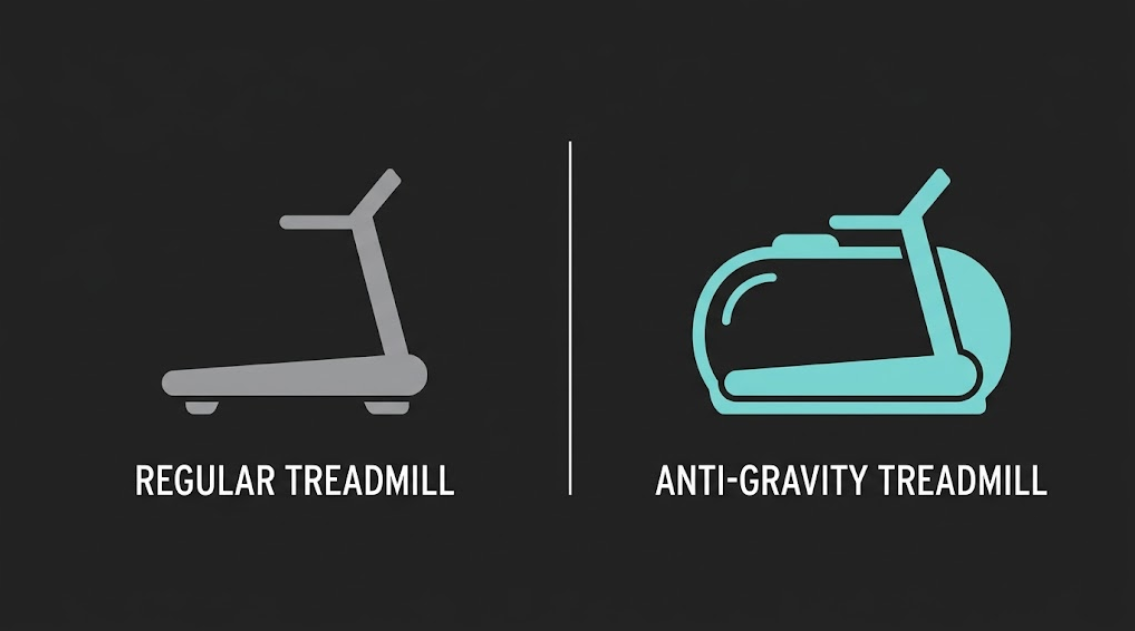
Factor | Anti-Gravity Treadmill | |
Impact on joints | Full body weight, cushioned surface helps somewhat | Reduced to 20-80% of body weight, significantly less joint stress |
Accessibility | Widely available at gyms and homes | Limited to specialized clinics, appointment-based |
Cost to use | Gym membership or home purchase | Per-session or clinical program fees, often physiotherapist-supervised |
Best suited for | Rehab, post-surgery recovery, specific medical or performance needs |
Cost and What to Expect
The equipment itself is priced well beyond what any individual would buy for home use, machines run from roughly $34,900 to $75,000 depending on the model, which is why they're almost exclusively found in clinical settings. As a patient or client, you won't be buying the machine, you'll be paying for supervised session time at a clinic offering it, priced similarly to a specialized physiotherapy session rather than a gym visit.
If you think this kind of rehab technology might genuinely help your recovery, the right first step is a conversation with a physiotherapist or sports medicine doctor about whether it's appropriate for your specific situation, not just seeking one out because it sounds impressive.
Conclusion
An anti gravity treadmill is a genuinely useful piece of rehab and training technology, not a gimmick, but it's specialized clinical equipment found at physiotherapy and sports medicine centers rather than your average gym. If you're recovering from an injury or surgery, it's worth asking your physiotherapist or doctor whether it's a fit for your recovery plan. If your main goal is simply reducing everyday joint strain during regular training, browsing gyms near you with good quality standard equipment and proper guidance will likely serve you just as well.


