


Chest Workout at Home: Complete Plan for 2026
No bench, no barbell, no problem. A genuinely effective chest workout at home comes down to changing your hand position and body angle on a handful of push-up variations, not needing a gym's worth of equipment. Each angle shifts the emphasis across your chest differently - upper, lower, inner, or outer, giving you the same kind of targeted development a bench press and cable crossover setup would, just using your own bodyweight instead. This guide covers a complete routine, a beginner-friendly entry point if standard push-ups are still too tough, and the progression system to keep building strength once the basics stop being a challenge.
Why Push-Ups Cover More Ground Than People Assume
The standard push-up already trains your chest, front shoulders, and triceps in one movement, plus your core to keep your body rigid through the rep. What most people miss is that changing your hand width and body angle meaningfully shifts which part of the chest does the most work, the same way changing a bench angle does with a barbell. That's the whole foundation of a genuinely complete home chest routine: one exercise, several angles.
This matters because a lot of home workouts for chest content stop at "do push-ups" without explaining why variation matters. Your chest isn't a single uniform muscle; it's made up of fibers running in different directions across the upper, middle, and lower regions, and different pressing angles recruit those regions to different degrees. Training only standard push-ups leaves some of that development on the table, the same way only ever bench pressing flat would in a gym setting.
The Complete Chest Workout at Home Without Equipment
Aim for 3 to 4 sets per exercise, with the last 2 to 3 reps of each set feeling genuinely difficult while your form stays clean. Rest 45 to 60 seconds between sets.
Exercise | Sets x Reps | What It Targets |
Incline push-up (hands on a raised surface) | 3-4 x 12-15 | Lower chest, easier entry point for beginners |
Standard push-up | 3-4 x 10-15 | Overall chest, front shoulders, triceps |
Wide-grip push-up | 3-4 x 8-12 | Outer chest |
Decline push-up (feet on a raised surface) | 3-4 x 8-12 | Upper chest, front shoulders |
Diamond push-up | 3-4 x 6-10 | Inner chest, triceps |
Chair or countertop dip | 3-4 x 8-12 | Lower chest, triceps |
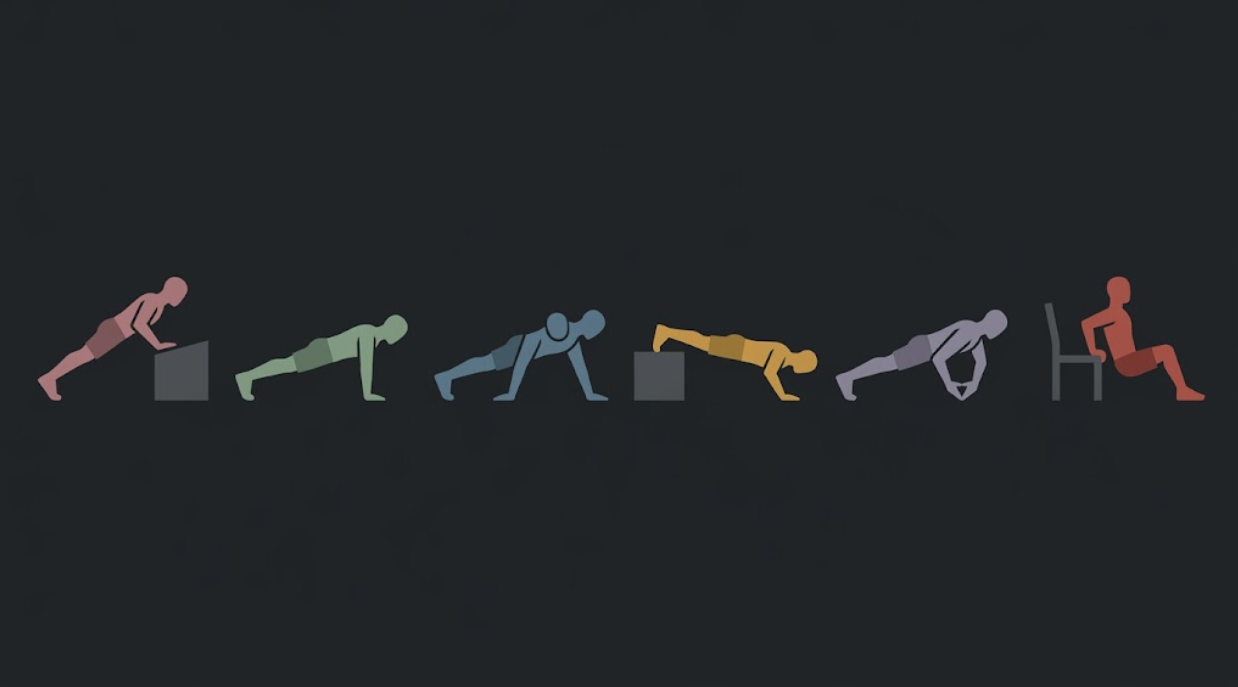
A full session covering all six lands around 25 to 30 minutes, including rest. If you're short on time, pick three or four rather than rushing through all six with sloppy form.
How to Progress Without Adding Weight
The same progression principles that apply to any bodyweight training apply here directly.
Leverage: move from incline push-ups to standard to decline as each level starts feeling manageable; the steeper the decline, the harder the chest has to work.
Tempo: slow the lowering phase to 3 to 4 seconds instead of dropping quickly; this alone can make a familiar push-up variation feel new again.
Single-arm emphasis: archer push-ups, shifting most of your weight to one arm at a time, significantly increase the demand once standard variations feel easy.
These three progression methods can also be layered together once you've got some experience under your belt; a slow-tempo decline push-up, for instance, combines two levers at once and is considerably harder than either modification alone. There's no need to master every possible combination; picking one or two progression methods and applying them consistently as your current variation gets easier is enough to keep making steady gains for a long time before you'd genuinely need external weight.
Chest Workout at Home for Beginners
If standard push-ups are still too difficult to perform with good form, start here instead of skipping straight into the full routine.
Wall push-ups: stand arm's length from a wall, hands flat against it, and perform the same pressing motion, a gentle starting point with minimal bodyweight resistance.
Knee push-ups: standard push-up form with your knees on the ground instead of your toes, reducing the effective load while you build strength.
Incline push-ups on a higher surface: a kitchen counter or sturdy table puts you at a steeper, easier angle than a chair or low bench.
Progress from wall to knee to incline to standard push-ups as each level becomes comfortable for 12 to 15 clean reps, rather than forcing standard push-ups before you're ready. There's no fixed timeline for this progression; some people move through it in a couple of weeks, others take a couple of months, and both are completely normal. Rushing to standard push-ups before you can perform them with a straight, controlled body line usually just teaches poor form that's harder to correct later than it would have been to build the base strength first.
Adding Resistance Without Buying Equipment
Once bodyweight push-up variations start feeling manageable even at the hardest angles, a few household items can add extra resistance without requiring an actual equipment purchase. A loaded backpack worn during push-ups adds meaningful extra load; simply adjust how much weight you pack in based on how challenging you want the set to be. A pair of full water bottles or bags of rice held in each hand can work for chest fly-style movements performed lying on the floor, mimicking the motion of a dumbbell fly with improvised weight. Neither of these fully replaces real gym equipment, but they extend how long bodyweight training alone can keep producing results before you'd need to consider a dumbbell set or gym access.
Chest Workout at Home for Men vs. General Routines
The routine above works identically regardless of gender; the exercises, angles, and progression system don't change based on who's doing them. A search for a home workout for the chest specifically by men usually reflects a focus on chest size and upper body fullness, which this routine already addresses through its combination of standard, wide-grip, and decline variations. There's no separate version of a push-up that builds a different kind of chest; the only real variable is how hard you push the intensity and how consistently you train.
Common Mistakes in a Home Chest Workout
Flaring the elbows too wide: keeping elbows at roughly a 45-degree angle from your body protects your shoulders better than flaring them straight out to the sides.
Sagging hips: a dropping midsection turns a chest exercise into extra lower back strain; keep your body in a straight line from head to heels throughout.
Only doing standard push-ups: relying on one variation skips the upper and lower chest emphasis that incline and decline positions specifically provide.
Rushing the reps: fast, bouncy push-ups reduce time under tension and make the exercise noticeably less effective than slow, controlled reps.
Not tracking progress: without some way of remembering last session's reps, sets, or how a variation felt, it's easy to plateau without noticing; jotting down a quick note after each session makes it obvious when it's time to progress to a harder variation.
Recovery Between Chest Sessions
Chest muscles, like any muscle group, need genuine recovery time to actually grow stronger between sessions, typically 48 hours at minimum before training the same muscle group with real intensity again. Soreness in the first day or two after a session is normal, especially when you introduce a new variation your chest isn't used to, but soreness that persists well beyond 72 hours or sharp joint pain rather than muscle fatigue is worth paying attention to and backing off from. A few minutes of chest and shoulder stretching after each session, holding a doorway chest stretch or a cross-body shoulder stretch for 20 to 30 seconds, helps maintain range of motion as you build strength.
Building Chest Training Into Your Week
Two to three chest-focused sessions a week, with at least a day of rest between them, is enough for real progress. If you're training other muscle groups too, this chest routine pairs naturally with the shoulder workout and back workout already covered on this blog, giving you a complete upper body split without ever needing gym equipment.
A simple weekly structure might place chest training on Monday and Thursday, shoulders on Tuesday, and back on Wednesday and Saturday, with rest or light activity on the remaining days. This spacing gives each muscle group adequate recovery time while still training frequently enough to make consistent progress, and it scales naturally. If you're only able to commit to two or three total sessions a week right now, a full-body approach touching chest, back, and shoulders each session works just as well until your schedule opens up for more dedicated days.
If you find yourself stuck at the same difficulty level for weeks despite trying the progression methods above, or you're dealing with any shoulder discomfort during pressing movements, that's a reasonable point to get in-person guidance from a trainer who can actually check your form.
Conclusion
A chest workout at home doesn't need a bench or a rack to be genuinely effective; it needs the right push-up variations run through a real progression system. Start with the angle that matches your current strength level, work through incline, standard, wide, decline, and diamond variations across the week, and add tempo or single-arm emphasis once the basic reps stop being challenging and if you'd rather train around others or want access to real equipment on top of this routine, find a gym near you and build from there.

